
Buyer guide
Prepared by LD Screw · Reviewed · Practical guidance for fastener RFQ preparation.
DIN 934 and ISO 4032 both describe metric hexagon nuts, but they are not dimensionally identical. ISO 4032 is the current international reference for hexagon regular nuts with coarse-pitch metric threads from M5 to M39. Buyers working from an older DIN drawing should verify the width across flats, nut height, thread pitch, property class and project approval before accepting an equivalent.
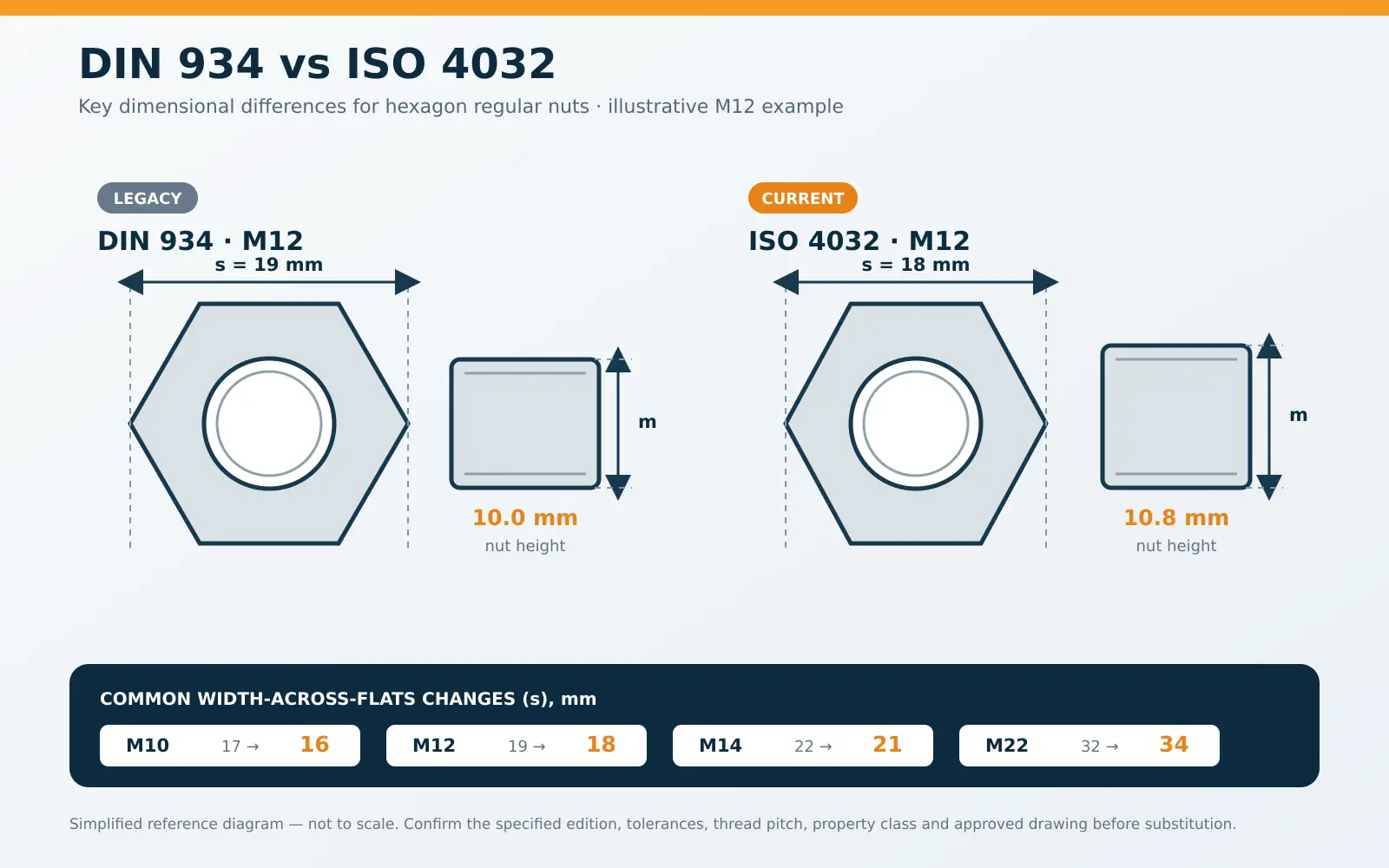
For M12, the reference width across flats changes from 19 to 18 mm and m max. from 10.0 to 10.8 mm. Check the approved drawing, wrench clearance, thread, property class and written substitution approval — not just the standard name.
Quick answer: similar product form, different specification details
DIN 934 is a withdrawn German standard that remains common on legacy drawings, distributor catalogs and buyer RFQs. ISO 4032 is the current international standard for hexagon regular nuts (style 1) with coarse-pitch metric threads. The standards describe a similar product family, but "similar" does not mean that every nut can be substituted without review.
The most visible change is the width across flats for M10, M12, M14 and M22. Nut height also differs across many common sizes. These changes can affect wrench fit, available clearance, thread engagement and the approved assembly envelope.
| Point to compare | DIN 934 | ISO 4032 |
|---|---|---|
| Status | Legacy / withdrawn DIN reference still used in purchasing | Current international reference; latest edition is ISO 4032:2023 |
| Product form | Metric hexagon nut | Hexagon regular nut, style 1 |
| Thread direction | Historically used for coarse and fine-pitch inquiries | Coarse-pitch metric thread; ISO 8673 is normally referenced for fine pitch |
| Common size scope | Broader legacy range depending on edition and catalog | M5 to M39 in ISO 4032:2023 |
| Substitution | Check dimensions and order requirements | Do not assume automatic interchangeability |
Dimensions that buyers should compare
The symbols below use s for width across flats and m for nut height. The drawing is a simplified purchasing aid rather than a manufacturing drawing. Standard tolerances, chamfers, bearing-face details and thread requirements must be taken from the specified standard edition.
For M10, M12 and M14, the common ISO wrench size is 1 mm smaller than the DIN value. For M22, the ISO value is 2 mm larger. Even when the wrench size is unchanged, the reference nut height can differ.
| Metric size | DIN 934 m max. (mm) | DIN 934 s (mm) | ISO 4032 m max. (mm) | ISO 4032 s (mm) |
|---|---|---|---|---|
| M5 | 4.0 | 8 | 4.7 | 8 |
| M6 | 5.0 | 10 | 5.2 | 10 |
| M8 | 6.5 | 13 | 6.8 | 13 |
| M10 | 8.0 | 17 | 8.4 | 16 |
| M12 | 10.0 | 19 | 10.8 | 18 |
| M14 | 11.0 | 22 | 12.8 | 21 |
| M16 | 13.0 | 24 | 14.8 | 24 |
| M18 | 15.0 | 27 | 15.8 | 27 |
| M20 | 16.0 | 30 | 18.0 | 30 |
| M22 | 18.0 | 32 | 19.4 | 34 |
| M24 | 19.0 | 36 | 21.5 | 36 |
Reference nominal width-across-flats (s) and maximum nut-height (m) values are from Würth Industrie CONNECT Volume I. Confirm the governing edition and approved drawing for production and inspection.
Can ISO 4032 replace DIN 934?
It may be possible, but the answer depends on the controlled drawing, assembly clearance, available tooling, thread requirement, property class and customer approval. A purchasing team should not approve the change only because a supplier catalog writes "DIN 934 / ISO 4032."
For maintenance or replacement work, confirm that the selected wrench or socket fits and that the increased or reduced nut dimensions do not interfere with adjacent parts. Some legacy DIN 934 nuts were specified for lower proof loads: do not replace a full-load ISO nut with a lower-rated DIN nut. For a new design, the current ISO reference is generally the clearer starting point when it matches the engineering requirement.
- Compare nominal size, pitch, width across flats and nut height
- Check available socket, spanner and assembly clearance
- Confirm material, property class, coating and thread tolerance separately
- Obtain written buyer or engineering approval when the drawing names DIN 934
Coarse thread, fine thread and property class
The dimensional standard does not complete the purchase specification. ISO 4032 is used for coarse-pitch metric nuts; ISO 8673 is the usual related reference for fine-pitch hexagon regular nuts. State the actual pitch whenever there is any risk of confusion.
Material and mechanical performance must also be defined. Carbon-steel property class, stainless-steel grade or property class, surface finish, marking and inspection documents should be written into the RFQ and purchase order rather than inferred from the standard number.
- Example coarse thread: ISO 4032, M12 × 1.75
- Example fine thread direction: ISO 8673, M12 × 1.5
- Add carbon-steel property class or stainless material and property class
- State plain, zinc plated, hot-dip galvanized or other required finish
How to write a clear hex nut RFQ
A useful inquiry line identifies the exact standard and edition when controlled, thread size and pitch, material or property class, finish, quantity and documentation. Attach the assembly drawing when wrench clearance, bearing area or overall height is critical.
Example: "ISO 4032 hexagon regular nut, M12 × 1.75, property class 8, zinc plated, 25,000 pieces; confirm coating requirement, inspection document, packing and lead time."
- Standard and edition or approved buyer drawing
- Nominal diameter, pitch and thread tolerance
- Material, property class, finish and marking
- Quantity, inspection documents, packing and destination
DIN 934 vs ISO 4032 Hex Nuts FAQ
Are DIN 934 and ISO 4032 the same?
No. They describe a similar hex-nut product family, but dimensions and thread scope are not identical. Width across flats differs at M10, M12, M14 and M22, and nut height differs across many common sizes.
Which wrench sizes changed from DIN 934 to ISO 4032?
The commonly cited changes are M10 from 17 to 16 mm, M12 from 19 to 18 mm, M14 from 22 to 21 mm, and M22 from 32 to 34 mm.
Can an ISO 4032 nut replace a DIN 934 nut?
Only after the drawing, wrench fit, assembly clearance, thread pitch, property class and project approval have been checked. Do not assume automatic interchangeability.
Which ISO standard is used for fine-pitch hex nuts?
ISO 8673 is normally referenced for hexagon regular nuts with metric fine-pitch thread. The exact pitch should still be stated in the RFQ.
What information should a hex nut RFQ include?
State the standard, edition if controlled, diameter, pitch, material or property class, finish, quantity, required documents, packing and delivery destination.
Reference sources
Use the current purchased standard and approved project documents for production and acceptance. These links support the comparison above.